

Can You Use an HSA or FSA for a Walk-In Tub or Roll-In Shower?
Maybe. An HSA or FSA pays for qualified medical expenses, and a bathroom change made mainly for a medical reason can count, but your plan decides. Many administrators ask for a letter of medical necessity from a clinician, an itemized estimate and a paid invoice. Call the administrator before you order.
By Zach Wennstedt, owner of Aging Safely Baths. Walk-in tubs and roll-in showers, installed in all 50 states. BBB accredited since 2012.
Updated November 22, 2026
What do the HSA and FSA rules actually say?
Two IRS documents matter here. Publication 969 covers HSAs and FSAs. Publication 502 defines medical care and lists home changes that can count.
Publication 969 says an HSA pays for qualified medical expenses: medical care for you, your spouse or your dependents, not paid by insurance or anyone else. It also says expenses you had before you opened the HSA do not count. For an FSA, you give the plan a written statement from an independent third party saying the expense happened and what it cost, and you certify that nothing else repaid it.
Publication 502 says a home improvement can count as medical care when its main purpose is medical care for you, your spouse or your dependent. Its list for people with disabilities includes bathroom modifications. Neither publication names walk-in tubs or roll-in showers. So the decision usually comes down to your plan administrator and the paperwork you hand them.
For the tax-deduction side of this, read our separate guide: Is a walk-in tub tax deductible? This page is about spending HSA and FSA money.
How are an HSA and an FSA different for this purchase?
| HSA | FSA | |
|---|---|---|
| Whose money | Yours, in an account you own | Yours, held under an employer plan |
| Who decides if the expense qualifies | You, using IRS rules. A custodian may ask for records | The plan administrator, using the plan rules |
| Typical proof | Keep the letter, the estimate and the invoice in case of an IRS question | Written statement from an independent third party, plus your certification (Pub 969) |
| Timing | Expense must come after the HSA was opened | Plan year rules. Carryover or a grace period only if your plan allows it |
| First call | Your HSA custodian or a tax professional | Your FSA administrator |
Rules differ from plan to plan. The administrator has the final word on an FSA, so always ask first.
What is a letter of medical necessity?
A letter of medical necessity, often called an LMN, is a short letter from a clinician explaining why you need an item for a medical reason. The IRS publications we read do not require one for a home improvement. Many plan administrators ask for one anyway, and it helps if the IRS ever asks questions.
That matters for older readers and their families. A walk-in tub chosen mostly for comfort is a weak case. A roll-in shower chosen because a person can no longer step over a tub wall, or uses a wheelchair, is a stronger case when the letter says so plainly.
What does a letter of medical necessity usually include?
Every plan words it a little differently, so ask your administrator whether they have a form. Most letters cover the same points:
- The patient's name and the date.
- The diagnosis or condition, in the clinician's words.
- What the person cannot safely do now, such as step over a tub wall, stand for a shower or transfer from a wheelchair.
- What item is needed and why a standard tub or shower does not meet the need. For example, a roll-in shower with a seat, or a walk-in tub with a door.
- How long the need is expected to last.
- The clinician's signature, license number and contact details, on letterhead if possible.
Who can write it? Often a physician, nurse practitioner, physician assistant, physical therapist or occupational therapist. Ask your plan who it accepts. An occupational therapist who has seen you in your own bathroom can describe the problem very clearly.
A letter says what is needed, not which brand. Our products are designed to make bathing safer when installed and used properly. We cannot say a tub treats or prevents a condition, and a good letter does not ask us to. It describes your needs. We supply the itemized estimate.
What paperwork should I gather?
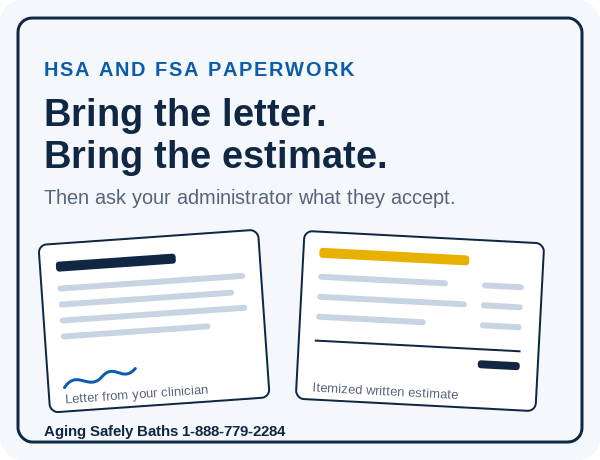
- The letter from your clinician.
- An itemized written estimate. Ask us for one. It lists the product, the installation and any extras on separate lines, so the administrator can see what is accessibility work.
- The invoice and proof of payment. FSA claims are normally reimbursements, so keep the paid receipt.
- Your plan's claim form or card instructions. Some plans let you pay with the card, some only reimburse.
- A note of who you spoke to, with the date and a reference number.
Does timing matter, and what about year end?
It can. FSA plans run on a plan year, and the IRS says a plan may allow a carryover of unused money, or a grace period, but only if the plan chooses to offer it. Your employer decides. Do not assume you have extra time. Ask your administrator for your exact deadline.
Then ask the question that matters for a big purchase: does the plan treat the expense as happening when you pay a deposit, when the product ships, or when the installation is finished? Our terms are 60% down (or the lower limit where state law sets one) on a white-glove full installation, and 100% at order on supply-only made-to-order products. Tell the administrator that schedule and ask how they would treat it. Get the answer in writing.
We cannot find an official source tying any December 31 deadline to walk-in tubs, so we will not make one up. Your plan document is the source to trust.
What does Aging Safely do, and not do?
How payment works with Aging Safely. 60% down (or the lower limit where state law sets one) on all white-glove full installations. 100% at order on supply-only made-to-order products. These terms apply to VA HISA and insurance cases too.
- We give you an itemized written estimate and an invoice you can submit yourself.
- We do not file claims for you, and we do not bill your HSA or FSA, an insurer, Medicare, Medicaid or the VA.
- You pay us directly, or you use financing. Then you seek reimbursement from your plan if it repays you.
Need the estimate now? Call us, or use the estimate tool on our VA page. An insurance version is being added.
What mistakes should I avoid?
- Paying first, asking later. Call the administrator before you order.
- Counting the same dollars twice. If a tax-favored account pays, ask a tax professional whether you can also deduct it. Generally you cannot count money that something else already paid.
- A vague letter. "Needs a new tub" is weak. A description of what the person cannot do is stronger.
- Mixing in cosmetic work. Ask for the accessibility items on their own lines.
- Missing the plan deadline. Check the date before you commit.
For other ways to pay, see our hub: paying for a walk-in tub or roll-in shower. If your administrator also asks for an itemized estimate, you can build one in about two minutes. This is general information, not tax, legal or insurance advice. Ask your administrator and a tax professional about your own case.
Frequently asked questions
Can I use an HSA to pay for a walk-in tub?
Possibly. IRS Publication 969 says HSA money is for qualified medical expenses, which means medical care. A bathroom change can count when its main purpose is medical care, but walk-in tubs are not named. Keep a clinician letter, an itemized estimate and the invoice, and ask your custodian or a tax professional.
Will my FSA reimburse a roll-in shower?
Only if your plan accepts it. The administrator decides. Publication 969 says FSA claims need a written statement from an independent third party and your certification that nothing else repaid the expense. Call the administrator first and ask what proof they want for a home modification.
Do I need a letter of medical necessity?
The IRS publications we read do not require one for a home improvement, but many plan administrators ask for one. It also helps if the IRS asks questions later. Ask your administrator whether they have a form, and who they accept as the writer.
Who can write the letter?
Usually a physician, nurse practitioner, physician assistant, physical therapist or occupational therapist. Each plan has its own rule, so ask the administrator before you request the letter. An occupational therapist who has seen you in your own bathroom can describe what you cannot safely do now.
Can I use my FSA money at year end?
Check your plan document. The IRS says a plan may allow a carryover or a grace period, but only if the plan chooses to. Many employers set their own deadline. Ask your administrator for the exact date and how a deposit and an installation date are treated.
Does Aging Safely file the claim for me?
No. We do not bill HSAs, FSAs, insurers, Medicare, Medicaid or the VA. We give you an itemized written estimate and an invoice that you can submit yourself. You pay us directly or use financing, on our standard terms: 60% down (or the lower limit where state law sets one) on white-glove installations and 100% at order on supply-only made-to-order products.
Can I use an HSA or FSA and also take the tax deduction?
Not for the same dollars. Generally you cannot count money that another source already paid, and tax-free account money counts as another source. The portion you paid some other way may qualify. Ask a tax professional. Our tax deduction guide explains the 7.5% rule.
Sources
- IRS Publication 969 (2025), Health Savings Accounts and Other Tax-Favored Health Plans
- IRS Publication 502 (2025), Medical and Dental Expenses (capital expenses, improvements for disabled persons)
Last checked November 22, 2026. Programs and tax rules change. Confirm with the agency, your plan or a tax professional before you rely on them.
Questions about your bathroom? Talk to a real person.
Open 7 days, 7am to 8pm Mountain. Call, or ask us to call you back.