

By Zach Wennstedt, owner of Aging Safely Baths. Selling and installing walk in tubs and roll in showers in all 50 states since 2012; formerly sales manager for multi-million-dollar plumbing and national remodeling companies. Updated October 2026. Not legal, medical or benefits advice; program rules change, so confirm with the agency named.
We sell walk in tubs for a living, so you would expect this article to say they are perfect. They are not. Every product category has failure modes, and the walk in tub industry has a specific set of them that show up in the same order on every review site: the wait while it fills, the wait while it drains, the door seal, the water heater, the price, the hard sell. Most are avoidable, a few are real tradeoffs you should know before you buy, and one or two mean a walk in tub is the wrong product for the person. This is the complete list, from thirteen years of installs and service calls, with the fix for each.
The eleven complaints, ranked by how often we hear them: 1) sitting in the tub while it fills, 2) sitting wet while it drains, 3) water goes lukewarm, 4) the door leaks, 5) the step is higher than expected, 6) the seat is too narrow, 7) jets are loud or unused, 8) cleaning the jets, 9) the price was far higher than it should have been, 10) the sales visit, 11) it was the wrong product for a wheelchair user. Nine of the eleven are prevented by the right spec and an honest installer. Two are built into the product and worth accepting with eyes open.
1. "You sit there naked while it fills"
True, and it is the first thing we tell every caller. A walk in tub is filled with the door closed and the bather seated, because the door is in the side of the tub. Depending on water pressure and faucet, that is 6 to 12 minutes. In a cold bathroom, 10 minutes seated in an empty tub is unpleasant.
What fixes it: a fast-fill faucet (7 to 12 gallons a minute instead of the 4 to 5 of a standard tub spout); a heated seat and backrest, which most of our tubs offer, so the surface is warm the moment you sit; a bathroom door closed and a space heater or heat lamp for the winter; and a handheld wand turned on first so warm water runs over your legs while the tub fills. Bathers who do all four tell us the fill is a non-issue; bathers whose installer skipped the heated seat tell us it is the reason they stopped using the tub.
2. "You sit there wet while it drains"
Also true, and the one that irritates people most. The door cannot open until the water is gone, so a slow drain is time spent cooling off.
What fixes it: dual 2-inch drains. A single 1.5-inch drain empties a 50-gallon tub in 6 to 10 minutes; dual fast drains do it in 80 to 120 seconds. Every Hydro Dimensions, Ella and Meditub model we recommend has fast or dual drains available, and we spec them by default. A heated seat and a towel within reach cover the last minute. If a quote does not mention the drain, ask; it is the most important option on the sheet.
3. "The water goes lukewarm"
Not the tub. A 40-gallon water heater delivers about 28 usable hot gallons, and a 30 x 60 soaker with a bather in it wants about 35 to 45 depending on the season. The fill starts hot and finishes cool.
What fixes it: sizing the heater before the sale. A 50-gallon tank handles most tubs; two-seat and deep soakers want 65. The inline heater option holds temperature during the soak. Our water heater sizing guide has the numbers model by model. No national brand we know of checks this in the home visit; we check it on every quote.
4. "The door leaks"
The fear everyone has and the problem almost nobody actually gets, if the tub is installed properly. Inward-swing doors seal with water pressure pushing the door into the gasket, so they get tighter as the tub fills. Outward-swing transfer doors rely on a latch and a compression seal, and are the ones that need the install done right.
What causes real leaks: a tub set out of level (the door no longer meets the gasket evenly), a gasket with soap scum or a hair across it, a latch not fully closed, or a caulk failure around the surround rather than the door. What prevents them: a tub leveled on all four feet and fill-tested with the door closed for 20 minutes before the installer leaves (we do this on every job and it is on the written leak-protection guarantee), a bather taught to wipe the gasket, and a seal that is a wear item replaced every 5 to 8 years for the price of a service call. Lifetime shell warranties cover the shell; ask separately what the door seal warranty is. Hydro Dimensions, Ella and Meditub all cover it for years; most leaks reported on review sites trace back to installation, not the tub.
5. "The step is higher than I expected"
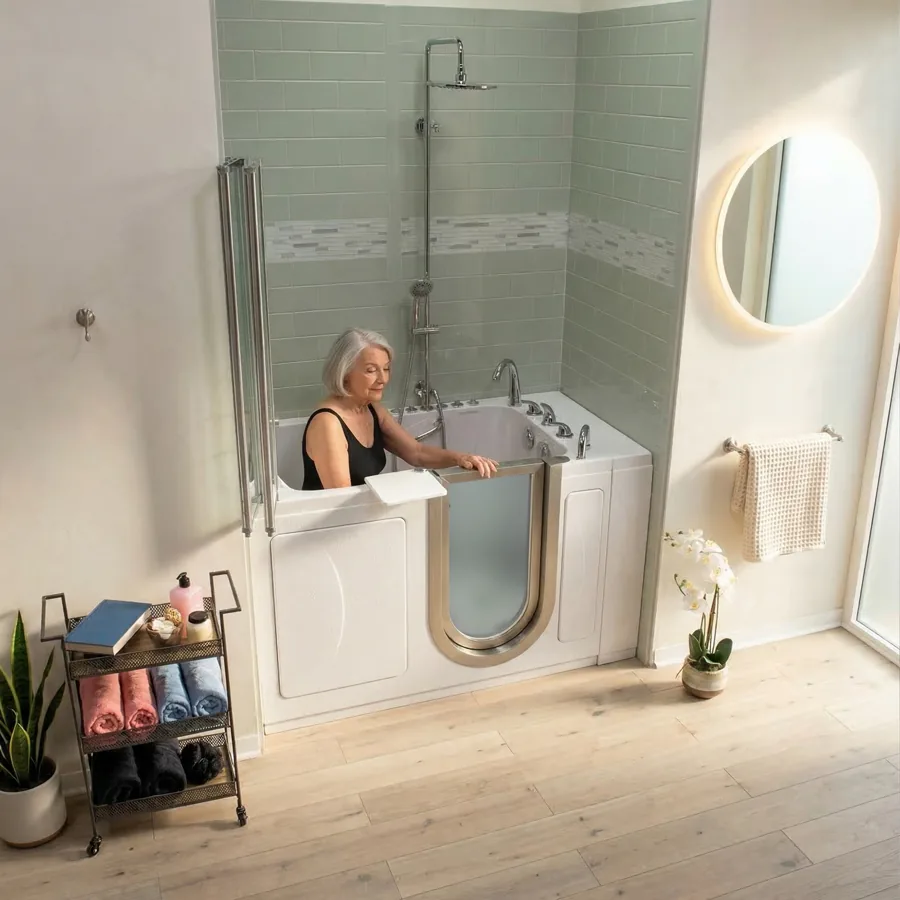
A walk in tub threshold runs 3 to 7 inches depending on the model, compared with the 14 to 20 inches of a standard tub wall. Seven inches is a big improvement; it is not nothing. Someone who cannot lift a foot 6 inches on a bad day cannot use a 6-inch door.
What fixes it: match the threshold to the person, not the brochure. Ella's low-threshold models sit at about 3 to 4 inches; several Meditubs are around 6; some Hydro Dimensions are 7. A full-time wheelchair user needs an outward-swing transfer tub with a seat-height cutout, or, usually better, a roll in shower with a threshold under 1.5 inches. We ask every caller the lift-a-foot question before we quote.
6. "The seat is too narrow"
Standard walk in tub seats are 19 to 21 inches wide. For many adults that is snug; for larger bathers it is unusable, and it is the complaint we see most from people who bought from a one-tub company.
What fixes it: measuring seated hip width and adding 2 inches before choosing. Wide-seat and bariatric tubs run 23 to 30 inches: the Ella TransferXXL, Big4One, Hydro Dimensions 3555 Plus and Meditub 3660. The finder filters by seat width; the bariatric page compares every wide model. A seat cushion from our accessories line fixes a seat that is the right width but too hard.
7. "The jets are loud" and "we never use the jets"
Water jets run on a pump; pumps make noise, roughly like a dishwasher. Air jets run on a blower, which is quieter but whirs. Both are often sold as the main event and then used a few times.
What fixes it: honesty before the sale. If the bather has arthritis, neuropathy or circulation problems, water jets earn their keep and the noise is a fair trade. If the goal is safe bathing and a warm soak, a soaker with a heated seat is thousands less and silent. We say this on every product page. Microbubble systems are the quiet middle: a soft cloud of bubbles, a gentler pump, real skin benefits. Nobody should buy a dual-jet package because the presentation started there.
8. "Cleaning the jets is a chore"
Water jet lines hold a little water between baths, and over months that can grow film if the system is not flushed. Air jet channels can trap moisture too.
What fixes it: a tub with an auto-purge or self-drying blower (standard on most Ella air systems), a monthly flush with the manufacturer's cleaner or a cup of dishwasher detergent run through the jets for ten minutes, and an ozone or UV sanitizer option on tubs that offer it. Fifteen minutes a month. If that sounds like too much, choose a soaker; there is nothing to clean but the tub.
9. "We paid way too much"
The complaint with the most money behind it. The same class of tub, installed, is quoted at $25,000 to $30,000 by the TV brands and $15,000 to under $20,000 through the dealer channel. The difference is the commercial, the appointment setter, the commissioned closer and the financing spread.
What fixes it: an itemized written quote before anyone visits. The cost guide and the Safe Step investigation show the line items; the Kohler and Safe Step vs. Kohler pages cover the brands people compare. If you already signed, most states give a three-business-day cooling-off right on in-home sales; after that, the tub is still a good tub, just an expensive one.
10. "The sales visit was three hours"
In-home presentations are built to close that day: needs assessment, demonstration, high first price, cascading discounts, a manager call, a financing form. It works on tired people.
What fixes it: not having one. Photos and measurements through a virtual estimate or a phone call produce an itemized price the same day. Any company that insists on a visit "to measure" is there to close. The questions worth asking any seller are in our buyer's checklist.
11. "It was the wrong product for a wheelchair"
The complaint that is not fixable after the fact. A standard inward-door walk in tub requires the bather to stand, step in, turn and sit. A full-time wheelchair user often cannot, and a tub bought for them becomes a very expensive bench.
What fixes it: matching the product to the transfer. Wheelchair users who can slide sideways use an outward-swing transfer tub (Ella Transfer series, Hydro Dimensions W series) where the door opening comes down to seat height. Wheelchair users who shower in a chair or with a caregiver are usually better served by a roll in shower, which is faster to use, easier to assist in, and no more expensive. We quote both and say which we would buy. The wheelchair tub page and walk in showers for disabled people cover the decision.
The two tradeoffs that are built in
Be honest with yourself about these before buying, because no option removes them:
- You bathe with the door closed, so the fill and drain happen with you inside. Heated seat, fast fill, fast drain and a warm bathroom make it a short, comfortable wait. They do not make it zero.
- You cannot shower standing in most walk in tubs. The handheld wand works seated; a full-height shower over the tub requires the tub shower combo with wall panels and a rain head. If someone in the house showers standing, spec the combo from the start.
Problems that are really installation problems
| Symptom | Real cause | Prevented by |
|---|---|---|
| Door leaks at the bottom corner | Tub not level | Four-point leveling and a 20-minute fill test before the crew leaves |
| Water on the floor behind the tub | Surround or caulk failure, not the door | Wet-area wall panels, caulk tested, written leak guarantee |
| Tub rocks or creaks | Feet not adjusted, no mortar bed where required | Factory install spec followed; schematic on every product page |
| Pump trips the breaker | Shared circuit | Dedicated GFCI per motor, included in our installed price |
| Wand has low pressure | Undersized supply or valve limit | Pressure checked at quote; valve set at install |
| Door hard to latch | Hinge out of alignment after settling | Return visit under the leak-protection guarantee |
What the reviews actually say, brand by brand
Read a few hundred reviews across brands and the pattern is consistent: five-star reviews talk about independence and safety; one-star reviews talk about price, the sales visit, slow drains and service delays. Very few one-star reviews are about the tub failing. The TV brands collect more one-star reviews because the price and the visit are part of their model; dealer-channel tubs from Hydro Dimensions, Ella and Meditub collect fewer because the number was written down before anyone drove over. We keep our own record public on the reviews page, with links to the platforms that hold it.
A pre-purchase checklist that prevents every avoidable complaint
- Can the bather lift a foot 6 inches on a bad day? If not, transfer tub or roll in shower.
- Seated hip width plus 2 inches: pick the seat.
- Water heater size, fuel and age: match the tub or budget the heater.
- Fast-fill faucet and dual drains: on the quote, or ask why not.
- Heated seat: yes, nearly always.
- Jets: only if a condition justifies them; otherwise a soaker.
- Shower standing? Combo with wall panels.
- Itemized written price, 30-day validity, factory schematic attached.
- Who installs, who fill-tests, and what is the written leak guarantee?
- Door seal warranty and service contact after the sale.
Ten questions, five minutes. Every one of them is answered on our product pages or on the first call to 1-888-779-2284, and if the honest answer is "this person needs a shower," we say so.
Which complaints apply to which tub
Not every model carries every problem. The table scores the tubs we install most on the four complaints that depend on the model rather than the install.
| Model | Threshold | Seat width | Fast drain available | Fill demand | Best for |
|---|---|---|---|---|---|
| Ella Elite | About 3.5 in | 20 in | Yes, dual | Moderate | Low step, standard bathroom |
| Ella Ultimate | About 3.5 in | 20 in | Yes, dual | High | Deep soak, full therapy menu |
| HD 3060 | About 6 in | 21 in | Yes | Moderate-high | USA-made, 60 in alcove |
| HD 3555 Plus | About 6 in | 29 in | Yes | High | Larger bathers |
| Ella TransferXXL | Seat-height outward door | 29 in | Yes, dual | High | Wheelchair slide transfer |
| Ella Transfer30 | Seat-height outward door | 23 in | Yes, dual | Moderate | Wheelchair, standard alcove |
| Meditub 2646 | About 6 in | 19 in | Yes | Low | Small bathrooms, 40-gal heaters |
| Meditub 3060 | About 6 in | 21 in | Yes | Moderate | Value in a 60 in alcove |
| Ella Companion | About 3.5 in | Two seats | Yes, dual | Very high | Couples; needs a 65-gal heater |
| Ella Petite | About 3.5 in | 19 in | Yes | Low | Compact, low step |
| HD 3260D deep | About 7 in | 22 in | Yes | Very high | Tall bathers who want depth |
Conditions, and the feature that matters most for each
- Arthritis (hips, knees): the threshold and the seat height. Low-threshold Ella models and a 17 to 19 inch seat; water jets at the lower back and knees genuinely help, so this is the one case where the jet package is worth it.
- Parkinson's and balance disorders: grab bars on both sides of the door, a heated seat (less shivering, fewer tremors), a textured floor, and a fast drain so the exit is not rushed. Consider an outward door so a caregiver can assist from the front.
- Stroke with one-sided weakness: door side matters. The door should open on the stronger side so the bather enters leading with the strong leg. Every tub we sell comes in left or right door; we ask.
- COPD and heart failure: shallower, shorter, cooler baths. A compact tub with a 98 to 100°F limit, no more than 15 minutes, and a wand for rinsing. The inline heater is less important than a bath that is not too deep.
- Diabetes and neuropathy: the anti-scald limit set to 104°F and a floating thermometer; the bather cannot feel a burn coming.
- Dementia: simplicity. A soaker with a single lever, a heated seat, no jets to confuse, and a door latch a caregiver can operate from outside. Routine beats features.
- Obesity: a 26 to 30 inch seat, a 300 to 400 lb rated door, a wide outward door for transfers, and a 65-gallon heater because wide tubs hold more water.
- Wheelchair, full time: an outward transfer tub if the person slides independently; a roll in shower if a caregiver helps or the person does not soak.
If you already own a tub with one of these problems
Most of the complaints can be fixed on an existing tub for far less than a replacement.
| Problem | Retrofit | Typical cost |
|---|---|---|
| Slow drain | Dual fast-drain kit on tubs that accept it; otherwise a 2-inch drain and larger trap | $350 to $900 |
| Cold while filling | Heated seat retrofit (model-dependent), fast-fill faucet, bathroom heat lamp | $300 to $1,200 |
| Lukewarm water | Tank thermostat plus mixing valve; inline heater; 50-gallon tank | $250 to $2,500 |
| Door seal weeping | Gasket replacement and door realignment | Service call, $150 to $400 |
| Loud jets | Pump isolation pads; or disable water jets and keep air | $0 to $200 |
| Narrow seat | Padded seat cushion (adds comfort, not width); otherwise replacement | $90 to $250 for the cushion |
| Step too high | No retrofit; this is a replacement or a roll in shower |
We service tubs we did not sell. If the original company is gone, send the model number and photos through the virtual estimate and we will tell you what is possible.
A maintenance calendar that prevents most service calls
- After every bath: wipe the door gasket and leave the door ajar to dry.
- Weekly: rinse the seat and floor with the wand; check that the drain stopper seats fully.
- Monthly: run the jet-cleaning cycle or a cup of dishwasher detergent through the jets for 10 minutes; flush the tank drain a gallon.
- Twice a year: inspect the caulk line at the surround; check the latch alignment; test the GFCI buttons.
- Every 5 to 8 years: replace the door seal before it fails, not after.
Resale, removal and what a walk in tub does to a house
A walk in tub is a drop-in fixture in a standard alcove, so the bathroom can be converted back, and most buyers over 55, who are the fastest-growing share of the market, see one as a feature rather than a flaw. If you move, the tub stays; warranties are usually tied to the original purchaser at the original address, so ask about transferability if the house may be sold. Removal and replacement with a standard tub or a shower runs $3,000 to $6,000. In practice most tubs we install are still in use when the house changes hands.
When a walk in tub is simply the wrong answer
Three situations where we will tell you not to buy one from us or anyone: a full-time wheelchair user who does not want to soak (buy a roll in shower); a bather with severe dementia who will not tolerate waiting in a closed tub (a roll in shower with a caregiver is calmer); and a bathroom with a 40-gallon electric heater, no room for a bigger one and no budget to change it (a compact tub or a shower). Everyone else, with the spec above, gets a tub that works for a decade. That is the whole point of the list: these problems are known, and they are solvable before the tub is ordered.
Four service calls, and what they taught us
Omaha, a 'leaking' tub that was not. A daughter called certain the door was failing; water on the floor every bath. The crew found the caulk line at the back of the surround had separated where the house had settled. Re-caulked in an hour, door never touched. Lesson: most 'door leaks' are not door leaks. Ask the installer to check the surround first.
Tampa, the cold tub. A couple bought a two-seat tub from a TV brand and called us, not them, because the brand's service line routed to a subcontractor who could not come for three weeks. Their electric 40-gallon tank delivered 28 usable gallons against a 60-gallon operating fill. We did not sell them anything; we told them to replace the tank with a 65 and set the tub's inline heater, which the brand had installed but never switched on. Lesson: the heater is half the product.
Denver, the unused jets. An 84-year-old with a dual-jet package who used the tub as a soaker and resented the $4,000 she paid for jets she turned on twice. We disconnected the water pump at her request to stop the monthly cleaning and left the air system. Lesson: buy the jets for a reason or do not buy them.
Phoenix, the wrong product. A veteran in a wheelchair with an inward-door tub installed by a company that is no longer in business. He could not get in; his wife could not lift him. We removed it, installed a Bestbath roll in shower with a fold-up seat, and the VA HISA grant covered most of it. Lesson: the eleventh complaint is the only one that costs the whole purchase, and it is the easiest to prevent with one question on the first call.
How to compare any two tubs on these eleven points
Open the compare tool, pick two models, and check: threshold height, seat width, door swing, drain type, operating capacity, and the therapy packages. Then run the finder with the bather's needs (walker, wheelchair, wider seat, two people) and see which models survive. What is left is a short list, and every page on it carries the factory drawing with the dimensions so there are no surprises on install day. If the list is empty, that is the finder telling you the person needs a shower, and the shower hub is the next click.
Glossary: the terms sellers use to blur these problems
- Low threshold: anything under 7 inches on a walk in tub; under 1.5 inches on a roll in shower. Ask for the number, not the adjective.
- Fast fill: a faucet rated 7 gallons a minute or more. Ask the GPM.
- Quick drain / dual drain: two 2-inch drains, or a single enlarged drain with an air-assist. Ask the drain time in seconds for a full tub.
- Heated seat: an electric element under the seat and backrest, needs its own circuit. Ask whether it is included or an option.
- Inline heater: an element on the circulation line that holds temperature; requires water jets to circulate. It does not heat the fill.
- Operating capacity: gallons with a bather seated. The number that matters for the water heater.
- Transfer tub: outward door with the opening cut down to seat height so a wheelchair user slides across. Not the same as an outward door on a standard tub.
- Lifetime warranty: usually the shell only, original purchaser, original address. Ask about the door seal, pumps, and labor separately.
- Factory-certified installer: trained by the manufacturer on that tub. Ask which factory, and ask for the schematic the crew installs from.
- In-home consultation: a sales presentation. The price is set at the end of it.
If any of these eleven problems is the one you are worried about, say so on the first call. It changes which tub we quote, and sometimes it changes the product entirely; both are better outcomes than finding out after the install. 1-888-779-2284, seven days a week.
Before you call anyone
Write down five things: the bather's diagnosis in plain words, whether they can lift a foot six inches, their seated hip width, the water heater size, and whether a wheelchair is involved now or likely in three years. Those five answers decide which of the eleven problems you are at risk of and which tub, if any, is right. They take two minutes to collect and they are the first five things we ask.