

By Zach Wennstedt, owner of Aging Safely Baths. Selling and installing walk in tubs and roll in showers in all 50 states since 2012; formerly sales manager for multi-million-dollar plumbing and national remodeling companies. Updated October 2026. Not legal, medical or benefits advice; program rules change, so confirm with the agency named.
Type "free walk in tub" into a search engine and you get two kinds of results: companies that use the word "free" in an ad for a tub that costs $25,000, and well-meaning articles that say "ask Medicare" without mentioning that Medicare always says no. Neither helps. There is no program that mails you a free walk in tub. There are, however, eight real funding sources that pay for part or all of an accessible bathroom for people who qualify, and families combine them every week to get a walk in tub or roll in shower installed for little or nothing out of pocket. This guide lists each one with who qualifies, how much it pays, how long it takes, and how to stack them, in the order that usually works.
Nobody gives away walk in tubs. The sources that actually pay: 1) the VA HISA grant (up to $6,800), 2) state Medicaid HCBS waivers (typically $5,000 to $15,000), 3) Medicare Advantage home-safety allowances (a few hundred dollars), 4) Area Agency on Aging and Older Americans Act funds, 5) USDA Section 504 rural repair grants (up to $10,000), 6) state housing rehab and accessibility programs, 7) nonprofits such as Rebuilding Together and local Lions and Masonic lodges, 8) the federal medical expense tax deduction. Stacked, they routinely cover most of a $15,000 to $20,000 installed project. Financing and our discounts cover whatever is left.
First, the "free" ads and what they are
The ads promising a free walk in tub are usually one of three things: a "free estimate" (fine, everyone offers that); a "free upgrade" worth a few hundred dollars on a tub priced thousands over the dealer channel; or a lead-generation page that sells your phone number to in-home sales companies. None of them is a free tub. The real money comes from government and nonprofit programs that fund home modifications so that people can stay out of nursing homes, and those programs require paperwork, not a phone call to a TV number. The paperwork is not hard. We fill out our half of it every week.
1. The VA HISA grant: up to $6,800, the fastest real money
The Home Improvements and Structural Alterations grant pays for medically necessary home modifications for veterans enrolled in VA health care. It is not just for service-connected injuries: any enrolled veteran with a medical need can receive up to $2,000 lifetime, and veterans with a service-connected condition (or a non-service-connected condition rated 50% or more) can receive up to $6,800 lifetime. Walk in tubs, roll in showers, grab bars and widened bathroom doors are the most common HISA items. There is no income test.
- Who: veterans enrolled in VA health care with a physician's prescription for the modification.
- How much: $6,800 (service-connected or 50%+ rated) or $2,000 (others), lifetime.
- How long: 2 to 8 weeks from a complete application to approval, in our experience.
- How: VA Form 10-0103, a prescription from a VA or VA-authorized physician, and an itemized contractor estimate with a scope of work. Our VA HISA Estimate Planner builds the itemized estimate in about four minutes, in the format Prosthetics asks for.
- Tip: HISA can be used with every other source on this list. It is usually the first to pay.
2. Medicaid HCBS waivers: the biggest checks, state by state
Every state runs at least one Medicaid Home and Community-Based Services waiver that funds "environmental modifications" for people who qualify for a nursing-home level of care but want to stay home. Walk in tubs and roll in showers are approved routinely when a physician or occupational therapist documents that the person cannot bathe safely in the existing tub.
- Who: Medicaid-eligible seniors and adults with disabilities meeting the state's level-of-care test.
- How much: caps vary by state, commonly $5,000 to $15,000 per lifetime or per year; some states go higher case by case.
- How long: one to six months, longer where there is a waiting list.
- How: call the Area Agency on Aging, get assessed, enroll, get a case manager, submit a physician or OT letter plus an itemized quote and spec sheet, wait for the authorization, then install.
The full process, every state's program name, and the reasons requests get denied are in our Medicaid walk in tub guide.
3. Medicare: no, with one small exception
Original Medicare does not pay for walk in tubs, roll in showers or any bathroom modification; it does not classify them as durable medical equipment. The exception is that some Medicare Advantage (Part C) plans include a supplemental "bathroom safety" or "home safety device" allowance, typically $100 to $500 a year, which can cover grab bars, a shower seat, a handheld wand or a non-slip treatment. A few plans offer larger home-modification benefits for members with chronic conditions. Ask the plan directly for its "Special Supplemental Benefits for the Chronically Ill." Our Medicare page covers the details. Do not let anyone tell you Medicare will reimburse a tub after the fact; it will not.
4. Area Agencies on Aging and Older Americans Act funds
There are more than 600 Area Agencies on Aging in the United States, one for every county or region, funded under the Older Americans Act to help people 60 and over stay home. Many run small home-modification or "minor home repair" programs of their own, separate from Medicaid, with simpler income rules and no level-of-care test. Amounts are usually modest, $500 to $3,000, but they come fast and they can pay for the grab bars, the water heater or the electrical circuit around a tub that another source is funding. The AAA is also the front door for the Medicaid waiver, so one call starts both. Find yours through the Eldercare Locator (eldercare.acl.gov or 1-800-677-1116), or use the local resource block on our state pages; every state page names the agency.
5. USDA Section 504 Home Repair grants: rural homeowners 62 and over
The Single Family Housing Repair program pays grants of up to $10,000 to very-low-income homeowners aged 62 or older in eligible rural areas, specifically to remove health and safety hazards, which a bathtub someone cannot safely use qualifies as. Younger or slightly higher-income rural homeowners can get 1% loans up to $40,000 under the same program, and the two can be combined. "Rural" is broader than people think; many towns under 35,000 and the outskirts of mid-size metros qualify. Apply through the USDA Rural Development office for your state; expect a few months.
6. State and city housing programs
Separate from Medicaid, many states and larger cities run accessibility or housing rehabilitation programs funded by HUD Community Development Block Grants or state housing trust funds. Examples that come up on our quotes: Massachusetts' Home Modification Loan Program (0% loans, no Medicaid required, walk in tubs qualify); Pennsylvania's Access Home Modification Program; Minnesota's Rehabilitation Loan Program; Colorado's Home Modification Tax Credit; local CDBG rehab programs in cities like Houston, Phoenix and Columbus. The common thread: income limits around 80% of area median, owner-occupied homes, and an accessibility or safety purpose. The state housing finance agency or the city housing department is the place to ask, and our state pages list the programs we see most in each state.
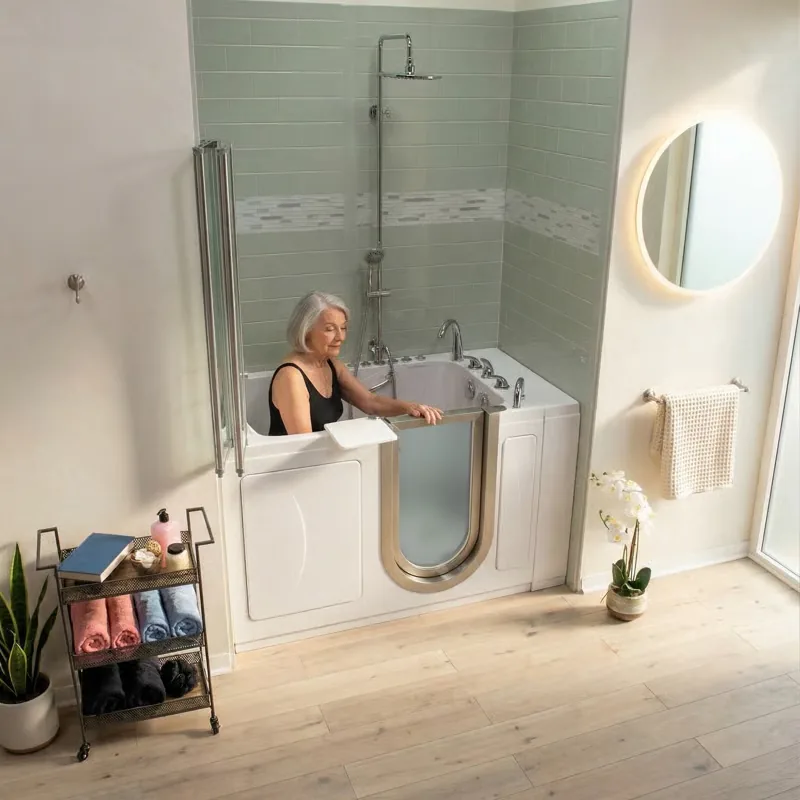
7. Nonprofits and service clubs
- Rebuilding Together (rebuildingtogether.org): national network of affiliates that repair homes for low-income seniors, veterans and people with disabilities at no cost, with volunteer labor and donated materials. Bathroom safety is one of their core programs; some affiliates install grab bars and shower conversions, and many will install a tub or shower the family or another program has purchased.
- Habitat for Humanity critical home repair programs, in many metros.
- Lions, Rotary, Kiwanis, Masonic lodges, Knights of Columbus, VFW and American Legion posts fund individual cases quietly all the time, especially for veterans and members. Ask; the worst answer is no.
- Disease-specific foundations (MS Society, ALS Association, Parkinson's Foundation, Muscular Dystrophy Association) run home-modification grants for people with those diagnoses, often $1,000 to $5,000.
- Churches and community foundations through benevolence funds.
- Independent Living Centers (ILCs) in every state help people with disabilities find and apply for every source on this list; they are free.
8. The medical expense tax deduction
When a physician documents that a walk in tub or roll in shower is medically necessary, its cost, minus any increase in the home's value, is a deductible medical expense on Schedule A to the extent total medical expenses exceed 7.5% of adjusted gross income. For a modification that does not raise the home's value, which is the IRS's own position on most accessibility work, the full cost counts. For a retiree with a modest income and a $16,000 tub, that deduction is often worth $1,500 to $3,500. Keep the prescription, the itemized invoice and a note from the installer that the work was for accessibility. This is tax information, not tax advice; confirm it with a preparer.
9. Financing, discounts and the dealer channel
Everything above assumes you need to lower the number. The other half of the answer is starting from a lower number. The same class of walk in tub, installed, is quoted at $25,000 to $30,000 by the television brands and $15,000 to under $20,000 through the dealer channel, with an itemized price and no visit. On top of that we run a standing veteran discount, a senior discount, and promotions that are listed on the promotions page, and financing turns the remainder into a monthly figure. A $6,800 HISA grant against a $15,250 installed price leaves $8,450; a waiver authorization of $5,000 leaves $3,450; the medical deduction returns some of that in April. That is how "free or nearly free" actually happens.
How to stack the sources, in the right order
- Veteran? Start HISA today; it is the fastest and it combines with everything.
- On Medicaid, or might qualify? Call the Area Agency on Aging the same day and ask for a waiver screening. Get on the list even if the bathroom can wait.
- Rural and 62 or older? Call USDA Rural Development.
- Everyone: ask the Area Agency on Aging about its own minor home repair funds and about state or city programs.
- Get one itemized quote from us with the spec sheet and schematic. Every program above accepts the same document.
- Get the physician or OT letter once and copy it to every application.
- Nonprofits last: they fill gaps better than they fund whole projects, and a letter saying "the VA is paying $6,800 and Medicaid $5,000, we need $3,000" gets a yes more often than a request for $15,000.
- Install after the last authorization, keep every receipt for the tax deduction.
What each source will and will not pay for
| Source | Walk in tub | Roll in shower | Grab bars | Water heater | Electrical | Demolition and labor |
|---|---|---|---|---|---|---|
| VA HISA | Yes | Yes | Yes | If medically needed | Yes | Yes |
| Medicaid waiver | Usually | Usually | Yes | Sometimes | Usually | Usually |
| Medicare Advantage allowance | No | No | Yes | No | No | No |
| AAA minor repair | Rarely (cap) | Rarely (cap) | Yes | Sometimes | Sometimes | Partial |
| USDA 504 | Yes | Yes | Yes | Yes | Yes | Yes |
| State/city rehab | Usually | Usually | Yes | Often | Yes | Yes |
| Nonprofits | Sometimes | Sometimes | Yes | Rarely | Rarely | Labor often |
| Tax deduction | Yes | Yes | Yes | If part of the modification | Yes | Yes |
Timelines, honestly
HISA: weeks. Area Agency on Aging minor repair: weeks. Medicaid waiver: one to six months without a waiting list, longer with one. USDA: months. State and city rehab programs: months, and many open and close application windows once a year. Nonprofits: unpredictable. If the bathroom is urgent because someone has fallen, say so to every agency; most have a priority path for documented falls, and in the meantime grab bars, a transfer bench and a handheld wand cost a few hundred dollars and reduce the risk now. Our accessible bathtub guide covers the stopgaps.
Four families, four stacks
Columbus, Ohio, veteran, 78. HISA $6,800 plus Ohio PASSPORT $5,000 against a $15,250 Hydro Dimensions 3060 installed. Out of pocket $3,450, financed at a low monthly payment, part of it recovered on his taxes.
Rural Nebraska, widow, 83, not a veteran. USDA Section 504 grant $7,500 plus the Area Agency on Aging $1,500 for grab bars and electrical against a $14,900 compact tub install. Out of pocket $5,900, paid from savings; the medical deduction returned about $1,200.
Tampa, Florida, wheelchair user, 66, on Medicaid. Statewide Medicaid Managed Care authorized a Bestbath roll in shower at $9,500; the Lions Club covered $2,000; the family paid about $3,700.
Boston, retired teacher, 74, over the Medicaid limit. Massachusetts Home Modification Loan Program at 0% for the full $16,100 Ella Elite install, repaid over several years, with the tax deduction taken in year one. Nothing out of pocket at install.
Scams and red flags
- Any company that says it will "handle the Medicare paperwork" for a walk in tub. Medicare does not pay; there is no paperwork.
- "Free tub with installation purchase," where the installation is priced at the whole tub.
- A demand to sign today to "lock in the grant." Grants come from agencies, not sellers, and they do not expire tonight.
- A request for your Medicare number to "check eligibility." Medicare fraud starts here.
- Any price that is not itemized, in writing, valid for 30 days.
What we provide for every application
- An itemized written quote with the tub or shower, demolition, plumbing, electrical and walls on separate lines.
- The manufacturer spec sheet and factory schematic with dimensions.
- A scope-of-work statement in the wording VA Prosthetics and Medicaid case managers expect.
- Our license and insurance information for the state.
- The VA HISA Estimate Planner PDF, which you build yourself in four minutes.
- Photos of the completed installation for the agency file.
Call 1-888-779-2284 or start with the virtual estimate. Tell us which programs you are applying to and we format the quote for each. There is no charge for any of it, and there is no visit.
HISA, step by step
- Confirm enrollment in VA health care (if not enrolled, apply at va.gov or the nearest VA medical center; enrollment is the gate for HISA).
- Ask the VA primary care provider for a prescription stating the modification is medically necessary. A VA physical or occupational therapy evaluation strengthens it and is often arranged by the same clinic.
- Complete VA Form 10-0103, Veterans Application for Assistance in Acquiring Home Improvements and Structural Alterations. One page.
- Attach an itemized contractor estimate with a scope of work, the contractor's license information, and a drawing or spec sheet of the product. Our planner produces this PDF.
- If the veteran rents or lives in a family member's home, attach the owner's written permission for the modification.
- Submit to the Prosthetics and Sensory Aids department at the VA medical center. Our state pages name the facility for every state.
- Wait for the approval letter with the authorized amount. Do not start work before it arrives; HISA will not reimburse completed work.
- Install, submit the final invoice and photos, and the VA pays the contractor or reimburses the veteran, depending on how the letter is written.
State spotlight: programs beyond Medicaid that fund bathrooms
Every state page on this site lists the Medicaid waiver and the local agency. These are the extra programs, outside Medicaid, that come up most on our quotes:
| State | Program | Who it is for | What it pays |
|---|---|---|---|
| Massachusetts | Home Modification Loan Program | Homeowners of any income level with a household member with a disability or age-related need | 0% or 3% loans to $50,000; walk in tubs and roll in showers qualify |
| Pennsylvania | Access Home Modification Program (PHFA) | Low-to-moderate income homeowners with a disabled household member | Deferred loans to $10,000 |
| Minnesota | Rehabilitation Loan Program and the Elderly Waiver | Low-income homeowners; seniors on Medicaid | Deferred loans to $37,500; waiver caps |
| Colorado | Home Modification Tax Credit | Residents making accessibility changes | Income tax credit up to $5,000 for qualifying modifications |
| Texas | Amy Young Barrier Removal Program (TDHCA) | Low-income homeowners with a disability | Grants up to $22,500 for accessibility work, through local administrators |
| Illinois | Home Accessibility Program (IHDA) | Low-income homeowners and renters with disabilities or over 62 | Forgivable loans to $25,000 |
| Ohio | Home Modification program through the Ohio Department of Aging and PASSPORT | Seniors on the PASSPORT waiver | Waiver-funded modifications |
| Florida | Weatherization and local SHIP (State Housing Initiatives Partnership) rehab | Low-income homeowners | Varies by county; many SHIP programs include accessibility |
| Washington | Home Repair and Weatherization through Community Action agencies | Low-income homeowners | Varies; accessibility often eligible |
| New York | Access to Home (NYS HCR) | Low-income households with a disabled member; veterans track | Grants to $25,000 through local administrators |
Programs open and close; confirm current status with the agency before counting on one. If your state is not listed, the state housing finance agency and the Independent Living Center are the two calls that find the equivalent.
The document checklist that serves every application
- Physician or OT letter: diagnosis, functional limitation, statement that the person cannot bathe safely, recommendation of the specific product, signed and dated.
- Itemized quote: product, demolition, plumbing, electrical, walls, labor, on separate lines; 30-day validity; license number.
- Manufacturer spec sheet and factory schematic (on every product page here).
- Scope-of-work statement in plain language.
- Proof of residence and, for renters, landlord permission.
- Income documentation for income-tested programs (tax return, Social Security statement).
- Photos of the existing bathroom.
- For veterans: DD-214 and VA enrollment confirmation.
Assemble it once, keep it in a folder, send copies. Half the delay in these programs is families re-gathering the same papers for each agency.
Common mistakes that cost people the money
- Starting the work before the authorization letter. Every program on this list reimburses nothing for work already done.
- Letting the physician write "patient would benefit from a walk in tub." Benefit is not necessity. The letter must say the person cannot bathe safely without it.
- Quoting the spa package. Reviewers see "chromotherapy" and stop reading. Keep therapy on a separate, family-paid line.
- Asking a nonprofit for the whole project. They fund gaps.
- Missing the appeal window on a denial. Most denials are fixable paperwork; the clock is 30 to 90 days.
- Signing a TV-brand contract "to lock in the grant." Grants come from agencies, not sellers.
A realistic twelve-week plan
| Week | Action |
|---|---|
| 1 | Call the Area Agency on Aging; veterans also call the VA clinic for the HISA prescription. Send photos for an itemized quote. |
| 2 | Physician or OT letter obtained. HISA packet submitted. Waiver assessment scheduled. |
| 3 to 4 | Waiver assessment completed; case manager assigned. Apply to any state or city program with an open window. |
| 5 to 8 | HISA approval typically arrives. Waiver authorization in progress; submit quote and spec to case manager. |
| 8 to 12 | Waiver authorization arrives. Approach a nonprofit or service club for any remaining gap with the two authorizations in hand. |
| 12 | Schedule the one-day install; keep receipts for the tax deduction. |
Some families finish faster; waiting-list states take longer. The order holds either way, and we will walk you through it on the first call.
If the person is not low income
Most of the list above is income-tested. The exceptions worth knowing: the VA HISA grant has no income test at all; Massachusetts' loan program and Colorado's tax credit are open at any income; the federal medical expense deduction scales with the tax bill rather than against it; and Medicare Advantage allowances depend on the plan, not income. For a middle-income family the usual stack is HISA if a veteran, the deduction, our discounts and the dealer-channel price, and financing. That alone typically turns a $25,000 TV-brand quote into a $15,000 installed project and a monthly payment the household can carry; the cost guide runs the numbers line by line.
Renters, family homes and multigenerational households
A renter can use HISA, most waivers and many nonprofit programs with the landlord's written permission, and a drop-in walk in tub or a roll in shower in a standard alcove is the kind of modification most landlords accept because it can be converted back. A parent living in an adult child's home is the most common case we see: the parent qualifies for the program, the child owns the house, and the agency wants the owner's signature on the application. Get it on the first visit, not the last.
The cost of doing nothing
The reason every one of these programs exists is that a fall is more expensive than a bathroom. The CDC counts roughly 3 million emergency department visits a year for falls among older adults, a large share of them in bathrooms, and the average inpatient stay after a fall runs well into five figures; a year in a nursing home runs $100,000 or more in most states. Our bathroom fall statistics page and the cost of a fall article lay out the sourced numbers. A $15,000 tub funded mostly by programs designed to prevent exactly that outcome is not a luxury purchase, and it helps to say so, in those words, in the application letter.
A note for Canada
The programs above are American. Canadian readers have provincial equivalents (Ontario's Home and Vehicle Modification Program, BC's Home Adaptations for Independence, Quebec's PAD, Veterans Affairs Canada's Veterans Independence Program) and the federal Home Accessibility Tax Credit. We ship walk in tubs and roll in showers to Canada supply-only with the same warranty; details on the Canada page.
Questions to ask any program before you count on it
- What is the maximum amount, per project and per lifetime?
- Is there an income or asset test, and what are the limits this year?
- Is there a waiting list, and is there a priority path for a documented fall?
- Do you pay the contractor directly or reimburse the family?
- Do you need one bid or three?
- What exactly must the physician letter say?
- Can this be combined with HISA, the Medicaid waiver, or a city program?
- How long from a complete application to an authorization letter?
Write the answers down with the date and the name of the person who gave them. Programs change rules mid-year, and a dated note is what gets an exception when they do.