

By Zach Wennstedt, owner of Aging Safely Baths. Selling and installing walk in tubs and roll in showers in all 50 states since 2012; formerly sales manager for multi-million-dollar plumbing and national remodeling companies. Updated October 2026. Not legal, medical or benefits advice; program rules change, so confirm with the agency named.
The single most common "the tub does not work" call we get has nothing to do with the tub. It is a 40-gallon water heater trying to fill a 70-gallon soaker, and a bather sitting in lukewarm water wondering why she spent $15,000. Water heater sizing is the step national brands skip in the kitchen-table presentation, and it is the step that decides whether a walk in tub gets used every day or becomes a very expensive shower. This guide gives you the real numbers: how many gallons each tub holds with a person in it, how much hot water a heater actually delivers, how to match the two, and what it costs to fix a mismatch before install day.
A walk in tub holds 40 to 80 gallons to the overflow but only 25 to 55 gallons with a person in it, and you bathe in roughly 100°F to 104°F water, which is a mix of about 70% hot and 30% cold from a 120°F heater. So a standard 30 x 60 soaker needs about 35 to 40 gallons of hot water. A 40-gallon tank delivers only about 28 to 30 usable hot gallons before it goes lukewarm, so it is marginal; a 50-gallon tank is the safe minimum for most tubs; a tankless unit rated 5+ GPM at your climate's inlet temperature works, and an inline heater on the tub keeps the water hot once it is in.
How much water a walk in tub really uses
Manufacturers list capacity to the overflow, with nobody in the tub. That number scares people and it is the wrong one. A person displaces water: roughly 10 to 15 gallons for an average adult, more for a bariatric bather. The number that matters is the fill with the bather seated, which the factory calls "operating capacity." Here are the tubs we install most, with both figures.
| Model | Size | To overflow (empty) | Operating (bather seated) | Hot water needed at 104°F |
|---|---|---|---|---|
| Meditub 2646 | 26 x 46 | about 40 gal | about 28 gal | about 20 gal |
| Ella Petite / Mobile | 26 x 45 to 28 x 52 | about 45 gal | about 32 gal | about 22 gal |
| Ella Elite / Standard | 30 x 52 | about 60 gal | about 45 gal | about 32 gal |
| Hydro Dimensions 3060 | 30 x 60 | 70 gal operating (factory) | about 50 gal | about 35 gal |
| Ella Ultimate | 30 x 60 | about 75 gal | about 55 gal | about 39 gal |
| HD 3555 Plus / Ella TransferXXL | 35 x 55 to 36 x 55 | about 80 gal | about 55 gal | about 39 gal |
| Ella Companion (two seats) | 32 x 60 | about 85 gal | about 60 gal | about 42 gal |
| Deep soakers (HD 3155, 3260D) | 31 x 55 to 32 x 60 | about 90 gal | about 62 gal | about 44 gal |
The "hot water needed" column assumes a 120°F heater and 55°F incoming cold water, mixed to 104°F. In Minnesota in January the cold water is closer to 40°F and you need more hot; in Phoenix in August it is 80°F and you need less. The sizing rule below builds in that margin.
How much hot water your heater actually delivers
A tank water heater does not give you its full volume as hot water. As hot water leaves the top, cold water enters the bottom and mixes, and the outlet temperature starts dropping after roughly 70% of the tank has been drawn. The industry number for this is the "first-hour rating," printed on the yellow EnergyGuide label, but for a single fill the simpler rule is: usable hot water is about 70% of tank size.
| Tank size | Usable hot water in one draw | Fills comfortably | Marginal | Will run cold |
|---|---|---|---|---|
| 30 gal | about 21 gal | Nothing on this list | 2646, Petite | Everything else |
| 40 gal | about 28 gal | 2646, Petite, Mobile | Elite, Standard, 3052 | 3060 and larger |
| 50 gal | about 35 gal | Up to 30 x 60 soakers | Ultimate, bariatric | Two-seat, deep soakers |
| 65 to 75 gal | about 45 to 52 gal | Everything including two-seat | ||
| 80 gal | about 56 gal | Everything, with a shower afterward |
Gas tanks recover faster than electric, which matters if someone showers right after the bath, but recovery does not help during the fill itself; the fill draws faster than any tank can reheat.
Tankless water heaters and walk in tubs
Tankless units never run out, but they can run slow. A tankless heater is rated in gallons per minute at a given temperature rise. The rise is the difference between incoming cold water and the output you want. Raising 40°F groundwater (a northern winter) to 120°F is an 80°F rise; raising 70°F water (a southern summer) is a 50°F rise. Most residential gas tankless units deliver about 5 to 6 GPM at a 50°F rise and 3 to 4 GPM at an 80°F rise. A walk in tub fast-fill faucet flows 7 to 12 GPM wide open, so with a tankless heater the faucet will throttle to what the heater can make, and the fill takes longer, not colder. Practical guidance:
- Gas tankless rated 180,000 BTU or higher (roughly 7 to 9 GPM at a 50°F rise): fills any tub on the list at a reasonable pace in most climates.
- Gas tankless rated 140,000 to 160,000 BTU: fine in the South, slow in the North; expect 12 to 15 minutes for a 30 x 60.
- Electric tankless: usually too small for a tub unless it is a 27 kW or larger unit on a 120-amp service; most are not. We see these cause the most complaints.
- Pair any tankless with the tub's inline heater option so the water stays at temperature once the fill is done.
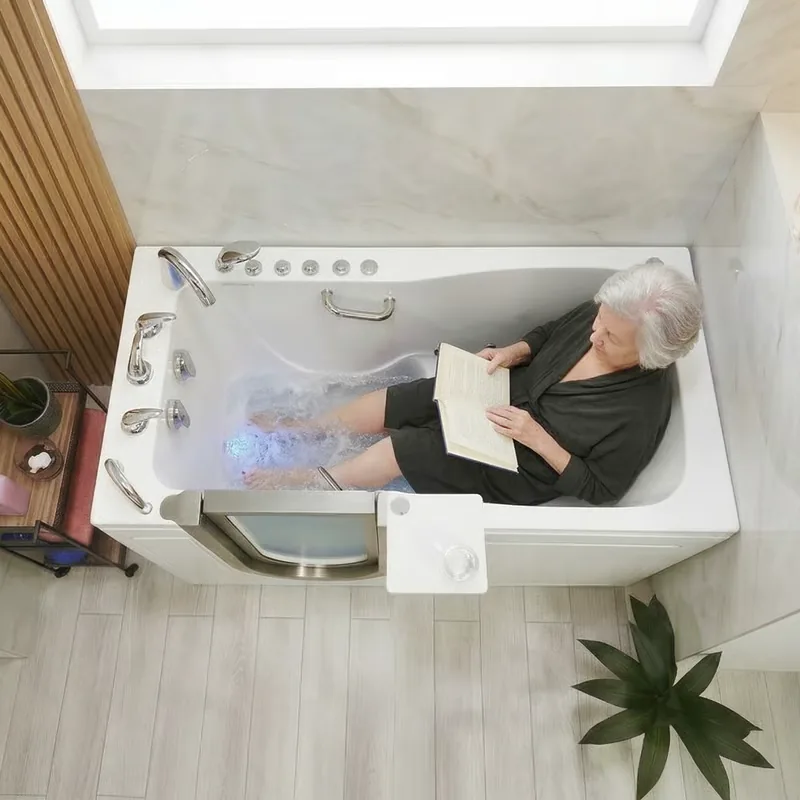
The four fixes when the heater is too small
- Replace the tank with a 50 or 65-gallon unit. The cleanest fix. Installed cost typically $1,500 to $3,000 for gas, $1,200 to $2,500 for electric, depending on venting and region. If the heater is over 10 years old it was due anyway.
- Add the tub's inline heater. A small electric heater on the tub keeps water at temperature during a 20 to 30 minute soak; it does not add hot water to the fill, but it means a slightly cooler fill is still warm at the end. Factory option on most models we sell.
- Raise the tank thermostat to 130°F to 140°F and add a mixing valve at the tank. A hotter tank stores more "usable" heat; the mixing valve at the tank outlet brings household water back to a safe 120°F. More usable gallons from the same tank, done by a plumber in an hour. The tub's own anti-scald valve stays as the second safety.
- Choose a smaller or shallower tub. A 26 x 46 or 28 x 52 compact tub with a 40-gallon heater is a better daily bath than a 32 x 60 that never gets hot. The product finder filters by size.
Fill time, drain time and the hot-water connection
Fill time is set by your water pressure and the faucet, not the heater, as long as the heater keeps up. Most homes at 50 to 60 psi fill a 30 x 60 soaker in 8 to 12 minutes with a fast-fill faucet; low-pressure well homes can take 15 or more. Drain time is set by the drain: a single 1.5-inch drain takes 6 to 10 minutes, dual 2-inch drains about 80 seconds. Sitting wet while a tub drains is the complaint people remember, so we spec dual drains on every tub that offers them. The walk in tub guide covers drain options model by model.
Water pressure and well homes
Hydrotherapy pumps do not care about pressure (they recirculate), but fill speed and the handheld wand do. Below 40 psi, a fast-fill faucet feels slow and a water jet system may cavitate on the initial fill. Well homes with a pressure tank should set the cut-in at 40 psi and cut-out at 60; a plumber can check this in minutes. Hard well water also scales up jets and heaters, so we spec a scale-tolerant faucet and recommend flushing the hydro system monthly.
Electric, gas, heat pump: which heater type suits a walk in tub
| Heater type | Pros for a walk in tub | Cons | Verdict |
|---|---|---|---|
| Gas tank, 50 gal | Fast recovery, cheap to run, plenty for one fill | Needs venting; not everywhere | The default answer |
| Electric tank, 50 gal | Simple, fits anywhere | Slow recovery: a shower after the bath may run cool | Fine for one bather; 65 gal for two |
| Heat pump (hybrid) tank | Very cheap to run | Slow recovery in heat-pump mode; set to hybrid/high-demand before a bath | Good if 65 to 80 gal |
| Gas tankless | Endless hot water | Flow-limited in cold climates; higher install cost | Good at 180k BTU+ |
| Electric tankless | No tank | Usually under-powered for a tub | Avoid unless 27 kW+ on a big panel |
| Point-of-use booster | Cheap | Too small to matter for a tub fill | No |
What we check before every installation
- Heater size, fuel, age and thermostat setting (from a photo of the label).
- Static water pressure at an outside hose bib.
- Distance from the heater to the bathroom; long runs in cold crawlspaces lose heat and waste the first gallons.
- Whether anyone showers right after the bather; this decides between 50 and 65 gallons.
- Climate: a northern home in winter gets the next size up.
If the heater is marginal, we say so on the quote and price the replacement as a separate line, so you decide. We do not sell water heaters; we tell you what to ask your plumber for. That is also what the TV-brand presentations generally skip, and it is why "my tub is cold" is a complaint on their review pages and not on ours.
Worked examples
Denver, gas 40-gallon tank, bather alone, wants a 30 x 60 soaker. Usable hot water about 28 gallons; the tub wants about 35 in winter. Options: a 50-gallon replacement ($1,900 installed by their plumber) or the thermostat-plus-mixing-valve fix ($250) with the inline heater option ($600). They chose the valve and inline heater; the tub fills warm and stays warm.
Tampa, electric 40-gallon, couple, Ella Companion two-seat. The Companion wants about 42 gallons of hot water; a 40-gallon electric gives 28. No fix short of a 65-gallon tank; they replaced it.
Minneapolis, 199,000 BTU gas tankless, Ella Ultimate. At an 80°F winter rise the unit makes about 4.5 GPM, so the fill takes about 11 minutes instead of 8. Acceptable; we added the inline heater.
Phoenix, 50-gallon gas, HD 3555 Plus bariatric. Summer inlet water at 80°F means the tub needs only about 28 gallons of hot; the 50-gallon tank is more than enough year-round.
Inlet water temperature by region, and why it changes the answer
The cold water entering your heater comes from the ground, and ground temperature tracks the local climate. A tub that needs 35 gallons of hot water in Atlanta needs closer to 42 in Minneapolis in February, because every gallon of 120°F water is mixed with colder cold water to reach 104°F. Approximate annual range of incoming water temperature:
| Region | Winter inlet | Summer inlet | Hot gallons for a 30 x 60 soaker (winter / summer) |
|---|---|---|---|
| Upper Midwest (Minneapolis, Fargo, Milwaukee) | 38 to 45°F | 60 to 65°F | 44 / 36 |
| Northeast (Boston, Albany, Burlington) | 40 to 48°F | 62 to 68°F | 43 / 35 |
| Mountain West (Denver, Salt Lake, Boise) | 42 to 50°F | 62 to 70°F | 42 / 34 |
| Mid-Atlantic and Ohio Valley | 45 to 52°F | 68 to 74°F | 40 / 32 |
| Pacific Northwest (Seattle, Portland) | 45 to 50°F | 58 to 64°F | 41 / 37 |
| Southeast (Atlanta, Charlotte, Nashville) | 52 to 58°F | 74 to 80°F | 37 / 29 |
| Texas and Gulf Coast | 58 to 66°F | 78 to 86°F | 34 / 26 |
| Florida and South Texas | 66 to 72°F | 82 to 88°F | 31 / 25 |
| Desert Southwest (Phoenix, Las Vegas) | 55 to 62°F | 80 to 90°F | 36 / 24 |
| California coast | 55 to 60°F | 66 to 72°F | 37 / 32 |
Read your row, take the winter number, and size the heater for that. A tank that is fine in July and lukewarm in January is the most common complaint we hear from people who bought elsewhere.
How to read the water heater label
Every tank sold in the United States has a yellow EnergyGuide label and a rating plate. Three numbers matter for a walk in tub:
- Nominal capacity (40, 50, 65, 80 gallons). Multiply by 0.7 for usable hot water in a single draw.
- First-hour rating (FHR). The gallons of hot water the heater can deliver in an hour starting full, which includes some recovery. For a single tub fill the 70% rule is more honest, but a high FHR means a shower after the bath will still be warm.
- Recovery rate (gallons per hour at a 90°F rise). Gas tanks recover 30 to 40 gallons an hour; electric 18 to 22; heat pump units 8 to 15 in efficiency mode. This is why an electric 50 is fine for one bath but not for a bath followed by two showers.
Send us a photo of the rating plate and we will tell you which column you are in. It takes less time than reading this paragraph.
Scald safety: the thermostat, the mixing valve and the tub valve
Older adults have thinner skin and slower reaction times; a 140°F tank can cause a serious burn in seconds. The safe arrangement, and the one most plumbing codes now require, is a tank thermostat at 120°F or a thermostatic mixing valve at the tank outlet if the tank is set hotter to stretch capacity. Every walk in tub we install also has a pressure-balance or thermostatic anti-scald valve at the faucet, set so the fill cannot exceed about 110°F regardless of what the tank does. Two layers, not one. If you choose the "run the tank hot, add a mixing valve" fix from the list above, have the plumber set and test both valves on the same visit.
Hydrotherapy systems and the heater: what interacts and what does not
- Air jets blow warmed air through the water; the blower has a small heating element that keeps the air from chilling the bath. No effect on the heater.
- Water (whirlpool) jets recirculate tub water through a pump; they do not add water. A pump on a cool bath makes it feel cooler, which is why the inline heater pairs with water jets.
- Microbubble systems recirculate too, and the cloud of bubbles can feel cooler on the skin; same answer, add the inline heater.
- The inline heater is a 1.5 kW element on the circulation line. It holds temperature; it cannot raise a 95°F bath to 104°F in any useful time. The fill has to start hot.
- Electrical: each pump, blower and heater needs its own dedicated GFCI circuit. A dual-jet tub with an inline heater is three circuits; we include up to 25 feet of run per circuit in the installed price.
Caregiver tips that make a small heater work
- Pre-fill before the bather undresses. Starting the fill ten minutes earlier means the water is at temperature when they sit, and the door is closed the whole time so there is no cold wait.
- Run the dishwasher and laundry after the bath, not before.
- If two people bathe, leave an hour between baths on an electric tank, twenty minutes on gas.
- Keep the thermostat at 120°F; raising it without a mixing valve is a scald risk, not a fix.
- Flush a few gallons from the tank drain twice a year; sediment steals capacity and recovery.
Troubleshooting a tub that runs cold
| Symptom | Likely cause | Fix |
|---|---|---|
| Fill starts hot, turns lukewarm halfway | Tank too small for the tub | Replace tank, or thermostat-plus-mixing-valve, or smaller tub |
| Fill is slow and lukewarm from the start | Undersized tankless or low pressure | Larger tankless, or raise well pressure; add inline heater |
| Bath is hot at first, cold after 15 minutes | No inline heater; large tub in a cold bathroom | Add the inline heater; close the bathroom door |
| Hot at the kitchen tap, cool at the tub | Long uninsulated pipe run | Insulate the run; pre-fill |
| Every fixture in the house is lukewarm | Failed element, thermostat or dip tube | Plumber: heater repair |
| Only the tub is cool, other fixtures fine | Tub valve limit set too low | Adjust the anti-scald valve limit stop |
What a replacement heater costs, roughly, by region
Prices customers report for a like-for-like 50-gallon replacement installed by a local plumber in 2026, before any utility rebate: $1,300 to $2,200 in the South and Midwest, $1,800 to $3,000 on the coasts and in the Mountain West, $2,500 to $4,500 for a gas tankless conversion anywhere. Heat pump water heaters cost more up front but many utilities rebate $300 to $1,000 and the Inflation Reduction Act tax credit covers 30% up to $2,000 through 2032. If the existing heater is over ten years old, replacing it in the same week as the tub install is the cleanest path, and the Medicaid waiver or VA HISA grant will sometimes fund it as part of the modification when a physician documents the need.
Roll in showers do not have this problem
A shower uses 2 to 2.5 gallons a minute, so a 40-gallon tank runs a 10-minute shower with room to spare. If the bather does not care about soaking, or the heater situation is bad and the budget is tight, a roll in shower or a tub shower combo sidesteps the whole question. We say this on every call where the heater is marginal, because a tub that runs cold is a tub that gets replaced in three years.
Test your own hot water in ten minutes
- Note the tank size on the rating plate and the thermostat setting (most are A/B/C dials; "A" is usually 120°F).
- Make sure nobody has used hot water for an hour.
- Put a kitchen thermometer under the tub spout or the closest full-flow faucet and open the hot side fully.
- Time it. Note when the temperature starts dropping noticeably (usually a 5 to 10°F drop over a minute). Multiply the minutes by the faucet's flow (a standard tub spout is about 5 gallons a minute; a bucket and a stopwatch tell you yours).
- That product is your usable hot water. Compare it to the "hot water needed" column for the tub you want. If it is within 10%, the inline heater closes the gap; if it is 25% short or more, size up the tank or the tub down.
Send us the number with your photos through the virtual estimate and it goes on the quote as a line item: "heater adequate," "marginal, inline heater recommended," or "replacement recommended, quoted separately."
Model-by-model heater recommendation
| Walk in tub | Minimum tank (South) | Minimum tank (North) | Tankless | Notes |
|---|---|---|---|---|
| Meditub 2646 | 40 gal | 40 gal | 140k BTU gas | Smallest hot-water demand we sell |
| Ella Petite / Mobile | 40 gal | 40 gal + inline heater | 140k BTU gas | Compact, good for 40-gal homes |
| Ella Elite / Standard 3052 | 40 gal + inline | 50 gal | 160k BTU gas | The most common upgrade point |
| Hydro Dimensions 3060 | 50 gal | 50 gal + inline | 180k BTU gas | Our best-selling soaker |
| Ella Ultimate | 50 gal | 65 gal | 180k BTU gas | Deep; worth the 65 up north |
| HD 3555 Plus | 50 gal | 65 gal | 180k BTU gas | Bariatric width, same water as a 3060 |
| Ella TransferXXL | 50 gal | 65 gal | 180k BTU gas | Outward door; same demand as Ultimate |
| Ella Companion (two seats) | 65 gal | 80 gal | 199k BTU gas | Two bathers, one fill |
| HD 3155 / 3260D deep soakers | 65 gal | 80 gal | 199k BTU gas | Deepest soak, most water |
| 6030 tub with transfer seat | 40 gal | 50 gal | 160k BTU gas | Shallower bathing position |
Questions to ask your plumber
- What is my tank's first-hour rating, and is it gas or electric?
- Can you set the tank to 130°F and add a thermostatic mixing valve at the outlet?
- Is the run from the heater to the bathroom insulated?
- If I replace the tank, does a 50 or 65 fit in the same spot, and does the venting change?
- For tankless: what GPM does it make at an 80°F rise in January?
- Does my electrical panel have room for the tub circuits (one per pump, blower or heater)?
Five myths
- "A walk in tub uses way more water than a regular tub." With a bather seated, a 30 x 60 walk in tub holds about the same 45 to 55 gallons as a standard tub filled to a comfortable depth. The difference is that you fill it with the door closed and the seat in the water, so the whole volume has to be warm before you enter.
- "Just turn the water heater up." Without a mixing valve that is a scald hazard, and it only buys a few gallons.
- "The inline heater fixes a small tank." It holds temperature; it cannot create it. It is the second half of a fix, not the first.
- "Tankless means instant." Tankless means endless; in a cold climate it also means slower.
- "The installer will handle the water heater." The national brands rarely check it. We check it on every quote and tell you in writing.
Bath temperature, skin and medical conditions
Comfort for an older adult is not the same as comfort for a 30-year-old. Skin thins with age, circulation slows, and conditions like diabetes and neuropathy blunt the sense of heat, which is how a bath that "feels fine" causes a burn. Most occupational therapists recommend 100°F to 104°F for a therapeutic soak, never above 108°F, and 98°F to 100°F for anyone with diabetic neuropathy, on blood thinners, or with heart failure, who should also keep soaks to 15 minutes and have someone within earshot. A tub whose fill arrives at 104°F and holds there with an inline heater is exactly right for that; a tub that arrives at 112°F because the tank was cranked up, or at 96°F because the tank was too small, is wrong in both directions. Set the tub's anti-scald limit to 104°F on install day, and if the bather cannot feel heat well, put a floating bath thermometer in the tub for the first few weeks. It costs five dollars and it is the single best accessory for a diabetic bather.
The one-page checklist for your plumber
- Tank size and fuel: ______ Age: ______ Thermostat: ______
- Usable hot water (tank × 0.7, or measured): ______ gallons
- Tub chosen: ______ Hot water needed (table above, winter column): ______ gallons
- Gap: ______. Under 10%: add inline heater. 10 to 25%: thermostat-plus-mixing-valve plus inline heater. Over 25%: replace tank or choose a smaller tub.
- Static pressure at hose bib: ______ psi (40 to 60 ideal)
- Circuits needed: ______ (one per pump, blower, heater), panel space confirmed: yes / no
- Mixing valve at tank outlet set to 120°F; tub anti-scald limit set to 104°F
Bring that sheet to the plumber or send it to us and the water heater question is settled before the tub ships, which is the whole point. Every other question about the tub itself, from door swing to seat width, is in the walk in tub guide and the finder.