

Signs Your Aging Parent Needs a Safer Bathroom, and How to Raise It
Look for a high tub edge, a towel bar used for balance, loose mats, dim light, pushing off the sink to stand, and a parent who bathes less. Raise it with a question, not a warning. Start with cheap fixes. Consider a roll-in shower or walk-in tub when stepping in is no longer safe.
By Zach Wennstedt, owner of Aging Safely Baths. Walk-in tubs and roll-in showers, installed in all 50 states. BBB accredited since 2012.
Updated November 22, 2026
What should I quietly look for in my parent's bathroom?
You are home for a few days. You use the bathroom, and you notice. Look first, say little, and take notes on your phone later. The goal is a list of small, specific things, not a verdict.
Here is what to scan. Each one is a visible clue, and none of them proves anything alone.
- The tub or shower edge. Is it high? Is there a wet-floor puddle outside it? Do they grab the towel bar for balance?
- What they hold. A towel bar is not made to carry body weight. A worn spot or a loose bar is a warning.
- Rugs and mats. Loose bath mats slide. CDC lists throw rugs and clutter among home fall hazards.
- Light. Is the path from the bedroom to the bathroom dark at night?
- The toilet. Is it low? Do they push off the sink to stand?
- Signs of avoiding the shower. Damp washcloths in the sink, fewer baths, or a story about "sponge baths now."
- Skin and body clues. New bruises, or a bandage they brush off.
- Things placed out of reach. Shampoo on the tub rim, or towels on a high shelf.
Why does this matter?
CDC says more than one in four adults 65 and older falls each year, with about 4.5 million emergency department visits and about 1.4 million hospitalizations a year from older adult falls (page last reviewed September 8, 2026). A CDC report on 2008 data, which is old but is the CDC bathroom study we cite, found that roughly 80% of bathroom injuries were caused by falls, and 68.3% happened in or near the tub or shower. Our bathroom fall statistics page has more.
No bathing product eliminates the risk of falls. Products are designed to reduce risk when installed and used properly. But the bathroom is a wet room with hard surfaces, and it is a fair place to start.
How do I bring it up without hurting their pride?
Most parents hear "we need to talk about your bathroom" as "you are getting old." So skip that opening. Try these instead.
- Start with a story. "My friend's mom slipped last month. It made me look at my own bathroom."
- Ask, do not tell. "Is the tub getting harder to climb into?" Then listen.
- Offer help with a task. "Can I put in a night light while I am here?"
- Keep it about their goal. Most people want to stay in their own home. A safer bathroom is a way to do that.
- Pick the moment. Not in front of the whole family at dinner. A quiet walk or a cup of coffee works better.
- Ask the doctor to raise it. A parent will often accept it from a clinician. Ask about balance, strength and medicines at the next visit. CDC lists poor strength and balance, and some medicines, as fall risk factors.
If a parent says no, leave it for now and try again later. Pushing hard can end the conversation for months.
A printable checklist for your visit
Print this page, or write the list on paper. Tick what you see.
- Tub or shower edge is high, or hard to step over
- No grab bar, or only a towel bar used for balance
- Loose bath mat or rug on a wet-prone floor
- Slippery tub or shower floor, no non-slip surface
- No seat or bench in the shower
- Dim light on the way to the bathroom at night
- Low toilet, or pushing off the sink to stand
- Supplies stored out of easy reach
- Parent avoids bathing, or bathes less often
- Parent needs help getting in, or is unsteady on a wet floor
- Parent uses a walker or wheelchair, and the bathroom door or space is tight
- Any fall or near-fall in the last year (ask gently)
Three or more ticks is worth a conversation and a call to their doctor. One tick may only need a small fix.
What low-cost steps can I take before any remodel?
Do these first. They are cheap, quick and often enough to buy time.
- Take up loose rugs and mats. Use a mat with a firm non-slip backing in the tub or shower.
- Add night lights along the path from bed to bathroom.
- Fit grab bars. They must be fixed into wall studs or solid backing by someone who knows how. A suction bar is not a safe substitute for a grab bar. Our 10-year bathroom safety planner covers placement.
- Add a shower chair or bench and a handheld shower. Sitting to wash is easier on tired legs. Our guide to shower chairs, tub benches and roll-in showers compares them.
- Raise the toilet seat, or add a frame, if standing up is hard.
- Move supplies to waist height.
- Ask about a home safety visit from an occupational therapist. Ask the doctor or your parent's plan how to arrange one.
If you help with bathing, two of our guides may help. How to bathe an elderly parent safely covers technique and dignity, and the caregiver bathing setup guide covers the room and the gear. This page is about spotting the problem earlier.
When does a roll-in shower or walk-in tub make sense?
Small fixes have limits. Consider a bigger change when:
- Your parent can no longer step over the tub wall, even with a bar and a bench.
- They use a wheelchair, a rolling walker or a rolling shower chair that needs to go in.
- A caregiver now lifts or steadies them, and that is hard on both of you.
- There has been a fall or a close call in or near the tub.
- They have stopped bathing as often as they should.
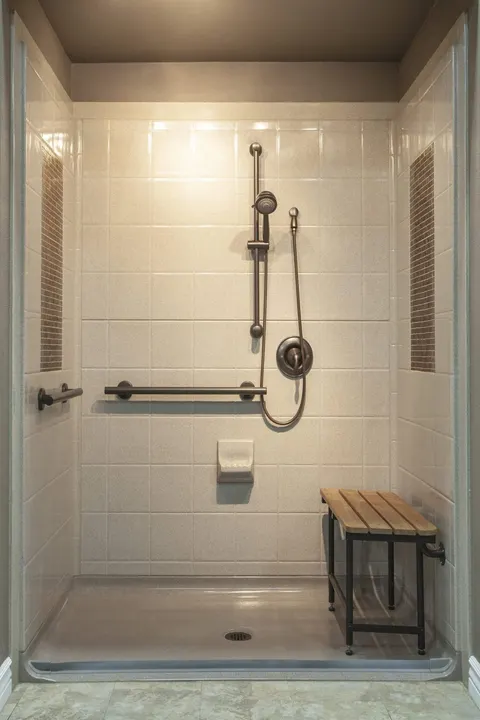
A roll-in shower has a very low or no threshold, so a wheelchair or rolling chair can go straight in, and a person who can stand can step in easily. Our roll-in shower guide explains the options. A walk-in tub has a door and a seat, so a person can step through a low opening instead of over a tub wall. It suits someone who can walk and wants to soak, though the tub must fill and drain while they sit. A tub-to-shower conversion is a third route.
The right choice depends on your parent's body, the room and what they want. Aging Safely sells and installs both, in all 50 states. We give an itemized written estimate by phone or from photos, with no high-pressure sales visit.
Worried about cost? See paying for a walk-in tub or roll-in shower. For payment terms, we ask 60% down (or the lower limit where state law sets one) on white-glove full installations and 100% at order on supply-only made-to-order products, and these terms apply to VA HISA and insurance cases too.
This page is general information and not medical advice. If you are worried about a parent's balance, falls or memory, call their doctor.
Frequently asked questions
What are the first signs a parent needs a safer bathroom?
Common clues are a high tub edge they struggle over, a towel bar used for balance, loose bath mats, dim light at night, pushing off the sink to stand, and fewer showers. New bruises or a story about "sponge baths now" can also be clues. One sign may need a small fix. Several together deserve a conversation.
How do I talk to my mom or dad about it without upsetting them?
Start with a story or a question, not a warning. Try "Is the tub getting harder to get into?" and then listen. Offer to help with a task, like a night light. Choose a quiet moment. If they say no, wait and try again. A doctor can also raise it.
What can I do in one afternoon?
Take up loose rugs, add a non-slip mat with firm backing, plug in night lights, move supplies to waist height, and add a shower chair and a handheld shower. Have grab bars fixed into studs by someone qualified. These steps are cheap and quick, and they may be enough for a while.
Is a walk-in tub or a roll-in shower better for an older parent?
It depends. A roll-in shower suits wheelchair and rolling-chair users, and many people who can stand but not step high. A walk-in tub suits someone who can walk, wants to soak and can wait while it fills and drains. A therapist who has seen the bathroom can help decide.
Will a walk-in tub prevent falls?
No bathing product eliminates the risk of falls. Walk-in tubs and roll-in showers are designed to reduce risk when installed and used properly, for example by removing the step over a tub wall. Good lighting, strength, balance work and a review of medicines also matter. Ask the doctor.
What does CDC say about older adult falls?
CDC says more than one in four adults 65 and older falls each year. It reports about 4.5 million emergency department visits and about 1.4 million hospitalizations a year from older adult falls. The page was last reviewed September 8, 2026.
Who pays for a bathroom change for a parent?
It varies. Some use savings, financing, an HSA or FSA, a VA grant for veterans, or a Medicaid waiver where a state offers one. Original Medicare generally does not pay. Our payment guide lists who to call. Aging Safely does not bill insurers or the VA.
Sources
- CDC, Older Adult Falls Data (last reviewed Sept. 8, 2026)
- CDC, Older Adult Falls: Data and Research (last reviewed Sept. 4, 2026)
- CDC MMWR, Nonfatal Bathroom Injuries Among Persons Aged 15 Years or Older, 2008 (published 2011)
Last checked November 22, 2026. Programs and tax rules change. Confirm with the agency, your plan or a tax professional before you rely on them.
Questions about your bathroom? Talk to a real person.
Open 7 days, 7am to 8pm Mountain. Call, or ask us to call you back.